On this page
Which industrial balls should Brazil buyers compare?
For industrial ball sourcing in Brazil, separate large-scale comminution media, fine-dispersion beads, food-refining media and precision machine components. These products have different equipment, wear and contamination requirements. Start with the machine-approved media or component specification, then compare composition, size distribution, process contribution and acceptance. A national mining opportunity does not make every steel sphere suitable for a mine, and a bearing-ball specification does not define grinding media.
Separate process media from precision components. For media, lead with mill compatibility, wear and contamination; for machinery parts, return to the controlled drawing.
1. Read the industrial signals through the component.
- ApexBrasil describes machinery serving agriculture, mining, food and other industries. This supports investigating several equipment functions rather than one universal grinding-ball product. [1]
- The ITA’s 2026 critical-minerals guide describes opportunities across different Brazilian states, including Minas Gerais. Its geography establishes mining context, not the required mill type or media specification. [2]
Our strongest content distinction is between media that participate in a process and precision balls that remain components in a machine. Within process media, large comminution, fine dispersion and food refining also need separate enquiry routes. The relevant buyer may be a process engineer, mill manufacturer or maintenance team. Identify that responsibility before recommending a material or comparing a price per kilogram.
2. Turn the local account into a useful enquiry.
| Buyer / catchment | Investigate this requirement | Ask before shortlisting |
|---|---|---|
| Mineral-processing account route | Identify ore/process, mill and media function | Ask for the equipment-approved media and process acceptance. |
| Food and industrial-processing account route | Separate refining, dispersion and fluid equipment | Define product contamination, wear and cleaning requirements. |
| Machinery and agricultural-equipment account route | Identify mechanical or valve components | Use the drawing and assembly, rather than a process-media specification. |
These are application-led account groups, not rankings of regional demand. For geographically distant operations, identify the actual test and receiving site. A Brazilian trading address may be far from the mill or plant that evaluates the sample. The process owner should confirm the equipment, product and acceptance before a logistics plan is compared.
3. Grinding media in Brazil: distinguish comminution from fine dispersion.
Start with the mill type and duty. Large-scale ore comminution and fine pigment dispersion do not use one interchangeable spherical-media specification. Provide the machine model, approved media material, nominal sizes and distribution, charge basis, operating mode and the process result that the buyer needs to preserve or improve.
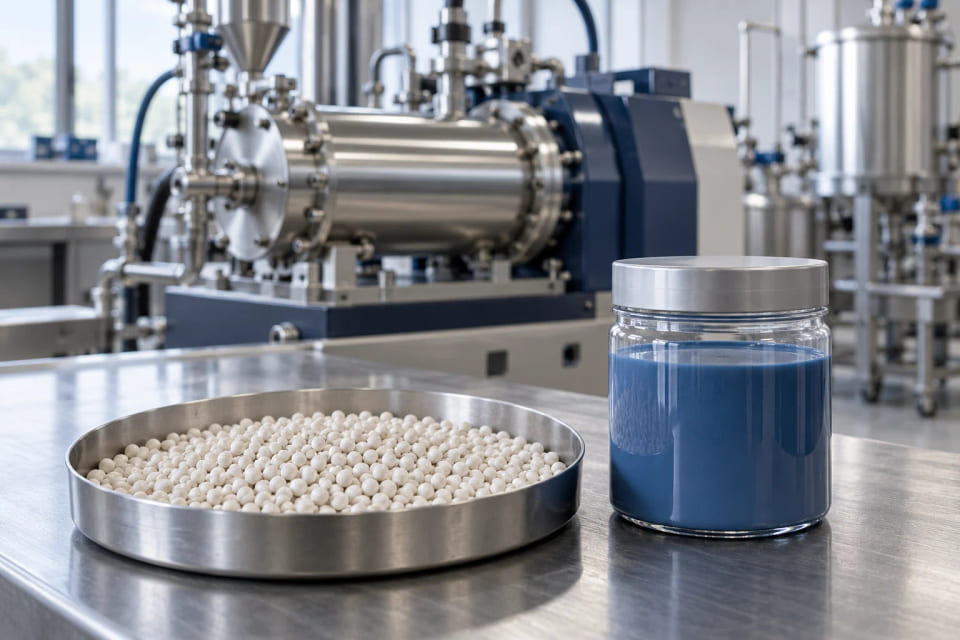
For a fine-dispersion project, investigate bead separation, formulation, wear and contamination alongside particle-size results. For another milling duty, use the equipment owner’s media and trial requirements. Keep the exact media composition visible. A white ceramic appearance does not identify zirconia formulation, and a hard steel sphere does not automatically qualify as the required grinding medium.
Explore grinding balls for fine grinding & dispersion ↗
4. Food and chocolate refining: evaluate the product contribution.
In food refining, media can contribute material through wear, so the accepted process result matters as well as size and appearance. Identify the refiner, equipment-approved media, product formulation, cleaning and the processor’s evaluation method. Do not substitute a bearing-ball acceptance plan for the media specification used by the machine.
Agree the trial quantity, conditions, separation and comparison with the existing approved media. Record the finished-product observations and any defined wear or contamination assessment. Contact documentation should refer to the exact material and intended use. A broad stainless or food-grade label does not establish the processor’s acceptance for every formulation or machine.
5. Machinery and agricultural equipment: return to component geometry.
A sphere inside a bearing, detent or valve remains a machine component even when the equipment serves mining or agriculture. Use the part drawing, material condition, finished geometry and mating interface. The surface and size requirements for a precision component should not be inferred from a grinding-media quotation.
For maintenance, identify the equipment and authorised repair route. If a pump or valve is involved, add the fluid, concentration, temperatures, seat and operating sequence. If rolling contact is involved, add the race or assembly and lubricant. The end industry provides exposure context; it does not replace the component’s functional specification.
Explore bearing & rolling-element balls ↗
6. Compare the candidate with the function.
Create two purchasing families from the outset: process media and precision components. Within media, retain the mill and product identity on every line. Compare composition, size distribution, wear and process performance on the same basis; within components, compare the released drawing and functional acceptance. That separation prevents a nominal spherical shape from hiding fundamentally different products.
| Product / material candidate | Why review it here? | Confirm before approval |
|---|---|---|
| Zirconia Balls & Grinding Beads | Suitable fine-grinding and dispersion media candidates | Specify ceramic formulation, size distribution, separator compatibility and contamination limits. |
| Steel Grinding & Refining Balls | Equipment-specified steel grinding or refining media | Confirm composition/condition, size mix, wear evaluation and machine-approved duty. |
| 316 / 316L Stainless Steel Balls | Suitable wetted machinery or process components | Define medium, temperature, seat, surface and finished-component records. |
| AISI 52100 Chrome Steel Balls | Drawing-specified mechanical rolling contact | Confirm finished geometry and assembly acceptance separately from grinding-media requirements. |
Review the linked material information alongside the application requirements. Exact grade, finished dimensions, supply and documents are confirmed for the specific component and order.
Have a component in mind?
Use the candidate list to start a focused discussion. Add the drawing, medium or contact that makes this application specific.
7. Make the specification usable at receiving.
A media RFQ should state equipment, media designation, size distribution, quantity, operating process, product and acceptance trial. A component RFQ should state part number, drawing revision, material condition, size/form/surface limits and records. Both need traceability, but their inspection and performance evidence answer different questions.
For a media alternative, define how the process engineer will compare the candidate with the current approved charge. Record whether the test is a laboratory screening, pilot trial or production evaluation. Do not treat a small laboratory result as a universal production-consumption or throughput guarantee.
| Requirement | Review before sampling | Preserve in the record |
|---|---|---|
| Fine-dispersion media | Composition, size distribution and equipment compatibility | Agreed process result, separator behaviour and contamination/wear evaluation. |
| Food-refining media | Approved material and processor trial | Machine, formulation, contact scope and accepted product observations. |
| Precision machine ball | Drawing-controlled finished component | Geometry, material condition and the relevant assembly test. |
8. Localise documents without changing the specification.
Use Portuguese descriptions that distinguish esferas de precisão from corpos moedores or the buyer’s own media terminology. Keep the manufacturer’s equipment and media identifiers unchanged. Where English data sheets support procurement, ensure the local process team understands which composition, size and trial conditions control acceptance.
Specify the documents the Brazilian buyer needs for the exact item and use. A process-media composition record is different from a precision-ball dimensional report or a food-contact assessment. Identify the processor or engineering party that approves each scope and agree which records accompany samples and repeat lots.
9. Plan delivery to the actual receiving team.
Name the trial and receiving plant, including onward transport from the entry point. For heavy media, compare packing, handling and receipt arrangements with the actual charge and storage plan. For small precision balls, use separated packs that preserve size and lot identity rather than applying the same packing concept to all spheres.
Schedule the sample against the process trial window and agree who records the result. If the material travels through a distributor, preserve composition and lot references. Actual supply, quantities, delivery terms and lead time must be reviewed per media or component line; no Brazilian stock or fixed nationwide delivery time is implied.
10. Compare the cost of an accepted component.
For media, compare cost in the context of accepted process performance and measured consumption, not only purchase price per kilogram. Include the trial, wear/contamination evaluation, packing and receiving work. Use the buyer’s measured operating result rather than a supplier’s unsupported claim of universal life or throughput improvement.
For a precision component, use cost per accepted part against the drawing. Keep its inspection and assembly approval separate from a media trial. Current landed-cost inputs should come from the responsible purchasing/import team for the actual item, origin and route rather than a generic country tariff estimate.
11. Move from a sample to a repeatable order.
For media, agree a staged comparison with the process owner and equipment requirements: document the current reference, screen the candidate under defined conditions and obtain approval before expanding the charge. Record product and wear observations so the result can be interpreted.
For a precision component, follow the drawing/sample/first-lot route instead. Do not extend a successful media trial into a claim about machinery components, or carry a food-refining approval to another formulation. The acceptance belongs to the defined equipment, material and process.
Function, material, finished requirements and approval owner.
Agreed inspection and application test with recorded conditions.
The accepted revision, lot identity, records and change route.
12. Questions Brazil buyers ask.
Are grinding balls and precision bearing balls interchangeable?
They should not be treated as interchangeable products. Grinding media are selected around equipment, composition, size distribution, wear and process contribution. Bearing balls follow finished-component geometry, material condition and assembly requirements. Start with the intended function.
How should a Brazilian dispersion buyer compare zirconia beads?
Specify the exact ceramic formulation, size distribution, mill/separator compatibility, product formulation and trial conditions. Compare the accepted process result and contamination/wear observations. White colour or a generic zirconia label does not define the complete medium.
Does this guide offer every mining grinding-ball size?
It identifies enquiry routes and material candidates rather than confirmed stock or every possible media product. Provide the mill, approved specification, sizes and quantity. The actual supply scope and required evidence must be reviewed before a quotation is treated as suitable.
What matters most in a chocolate-refining media enquiry?
Identify the refiner, approved media material and size distribution, formulation, cleaning, required contact records and the processor’s trial. Compare wear and product observations under agreed conditions rather than relying only on the media purchase price.
13. Prepare a Brazil component brief.
Illustrative request: a Brazilian dispersion producer is reviewing ceramic media for an existing bead mill. Identify the mill and separator, approved media formulation, nominal size/distribution, product formulation, trial quantity and process acceptance. Define the wear and contamination evaluation with the process owner. Compare the candidate with the current approved medium under agreed conditions; do not use the result as a claim about ore-grinding balls or bearing components.
Select the candidates and review topics relevant to your component. Add the size and quantity if known, then carry this brief into the enquiry page.
Select the product candidates and review topics you want to discuss.
The enquiry page prepares an email draft for your review. Nothing is sent automatically. Exact supply, documents and delivery terms are confirmed in the quotation.
Preview my enquiry brief
Market: Brazil
Sources and editorial scope
Research reviewed on 21 October 2026. Dated official publications establish industrial context. Buyer segments, product shortlists, sample plans and procurement examples are MEITUO-oriented editorial recommendations, not measured local ball demand, customer cases or national purchasing requirements.
- ApexBrasil: machinery and equipmentAgency industry overview. Machinery serving agriculture, mining, food and other industrial sectors.
- International Trade Administration: Brazil critical minerals by state2026 market intelligence. Geographical diversity of mineral processing opportunities, not media specification.
Application and material guidance is connected to the linked MEITUO application library and its technical references. Candidate products do not imply confirmed stock, certification, system ratings or qualification for every use. Images are explanatory CGI concepts.
A ball-focused website of Qingdao Meituo Steel Co., Ltd. Read the company profile or discuss the actual component.