Motion & handling
Balls for Linear Guides & Slides
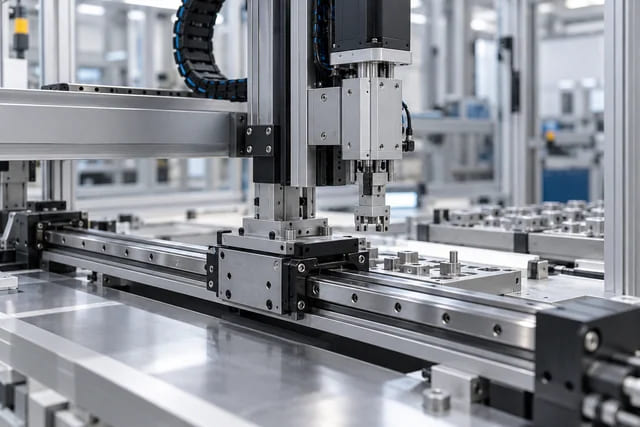
Ball recirculation, clearance and surface acceptance for guided motion.
Seven families, connected to the application.
Explore all products →Share the drawing, contact conditions and acceptance criteria for your component.
Material selection guide →Explore the contact, medium and mechanism.
All applications →Share the drawing, contact conditions and acceptance criteria for your component.
Material selection guide →From an open material question to an agreed component requirement.
Explore services →Share the drawing, contact conditions and acceptance criteria for your component.
Material selection guide →Industry and sourcing guides for twelve target markets.
Explore all markets →Share the drawing, contact conditions and acceptance criteria for your component.
Material selection guide →Match the component programme, purchasing role and project responsibilities.
Explore partnerships →Share the drawing, contact conditions and acceptance criteria for your component.
Material selection guide →Corporate background, practical purchasing information and direct contact.
Explore company →Share the drawing, contact conditions and acceptance criteria for your component.
Material selection guide →A detent ball contacts a recess or mating surface to locate, retain or index a moving component. Its diameter, material and surface must match the plunger or mechanism, spring conditions and mating feature. Review the complete contact system; a harder ball or stronger spring is not automatically an improvement.
A spring-loaded ball can provide a discrete locating action in a slider, flap or similar mechanism. The ball’s travel, retention and the shape of the mating recess influence how that action feels and repeats.
Identify whether you need loose balls, a ball-ended component or complete spring plungers. These are different scopes of supply. A threaded ball is also a different component from a spring plunger with a projecting sphere.
Use these inputs to move from an application name to a useful component and supply enquiry.
| Selection input | Describe your conditions | Why it belongs in the enquiry |
|---|---|---|
| Contact geometry | Ball size, projection, travel and mating recess. | Provide the complete contact arrangement or controlled component drawing. |
| Operating behavior | Locating, release, cycling and acceptable movement. | Define the intended mechanism behavior rather than ball hardness alone. |
| Environment | Lubrication, debris, cleaning and corrosion exposure. | Assess the ball, housing and mating surface together. |
Use the mechanism requirements to define the sphere. Changing ball size or material can affect contact and movement, while changing the spring changes the system again. Review proposed substitutions with the design owner.
For cycling applications, keep an agreed sample and record the component revisions used in its test. A part that locates once on the bench may show a different wear or release pattern after representative operation.
| Material or product candidate | Why review it here? | What must be confirmed? |
|---|---|---|
| AISI 52100 Chrome Steel Balls | A hardened steel candidate for specified mechanical contact. | Confirm the mating feature and approved material condition. |
| 420C Stainless Steel Balls | A hardened stainless candidate used in ball-plunger designs. | Use the exact component requirements and exposure conditions. |
| POM Balls | A polymer candidate for a design that permits different contact behavior. | Review deformation, wear and retention rather than assuming equivalence. |
These are application-review candidates. The exact grade, finished specification, supply scope and documents are confirmed in the quotation.
Evaluate repeated locating and release in the actual mechanism. Inspect both the ball and the mating recess, and keep the accepted operating condition with the dimensional and material specification.
Avoid this assumption. Do not treat a ball detent as an approved safety lock without the complete mechanism’s design and validation.
No. Specify whether the component is a fixed threaded sphere, a loose ball or a spring-loaded assembly.
The mating surface and contact conditions also matter. Review the complete pair and the observed wear mechanism.
Repeated locating and release, the intended spring and recess, and inspection of both contacting surfaces.
Use a related function to compare requirements without assuming the same ball specification applies.
Ball recirculation, clearance and surface acceptance for guided motion.
Component-specific requirements, qualification records and controlled revisions.

Surface recognition, support contact and complete-module validation.
Bring the material, size, operating conditions and quantity. Include the drawing and validation topics that matter to this project.
Elesa+Ganter ball spring-plunger construction
References describe industry practice and material-selection context. They do not establish MEITUO stock, equipment ownership, qualification or performance.