On this page
Which industrial balls should Poland buyers compare?
For industrial ball sourcing in Poland, connect the buyer’s actual machine or process with a controlled component requirement. Automation and handling equipment need defined rolling or surface-contact behaviour; food machinery needs separate wetted-contact and cleaning information. Compare materials only after identifying the function, drawing and receiving test. Keep a distributor’s inventory item, an OEM drawing part and a maintenance replacement on distinct approval paths.
Build the enquiry around an automation interface, handling system or specific food-equipment component. Preserve end-user requirements when a distributor coordinates supply.
1. Read the industrial signals through the component.
- The ITA’s September 2025 manufacturing mission to Poland and Türkiye focused on industrial automation and precision machinery. This is a dated indication of industrial interest, not a forecast of ball orders. [1]
- Statistics Poland’s 2025 concise yearbook reports manufacturing by activity, including food and beverage production. Its industrial classification supports separating end-use sectors rather than treating manufacturing as one application. [2]
Our proposed focus is equipment-level sourcing: a builder choosing a repeat component, a handling integrator evaluating contact surfaces, or a food plant maintaining a defined valve. These are concrete conversations that can lead to a specification. Official industrial context helps identify them, while the final product recommendation must come from the assembly and acceptance requirements supplied by the buyer.
2. Turn the local account into a useful enquiry.
| Buyer / catchment | Investigate this requirement | Ask before shortlisting |
|---|---|---|
| Southern Poland interview route | Mechanical component and automated-equipment enquiries | Establish the design owner and the released drawing. |
| Central Poland interview route | Handling, equipment and food-process enquiries | Identify contact, cleaning and unit-level acceptance. |
| Western and other receiving sites | Distributor and multi-site supply programmes | Preserve part identity, origin and lot records through onward delivery. |
The regional routes are proposed interview groupings, not rankings or verified customer locations. Confirm current plant activity before assigning a product family. A distributor can serve several industries from one warehouse, so its location should not be used as evidence that every stock sphere has the same application or document requirement.
3. Automation components: keep fixture, guide and detent functions separate.
A machine builder may need balls for linear movement, spring-loaded positioning or a fixture interface. The same nominal diameter does not make those parts interchangeable. Request the drawing, contact geometry, motion and intended material condition. Identify whether the requirement belongs to a new machine design or a controlled maintenance replacement.
For a guide or carriage, include the mating assembly and lubricant in the validation discussion. For a detent, identify the spring/retention arrangement and the engagement surface. The useful acceptance is an agreed component inspection plus the relevant assembly observation. Avoid promising machine accuracy or service life from the loose-ball material name.
Explore balls for detents, indexing & positioning ↗
4. Transfer and handling balls: evaluate marking and movement together.
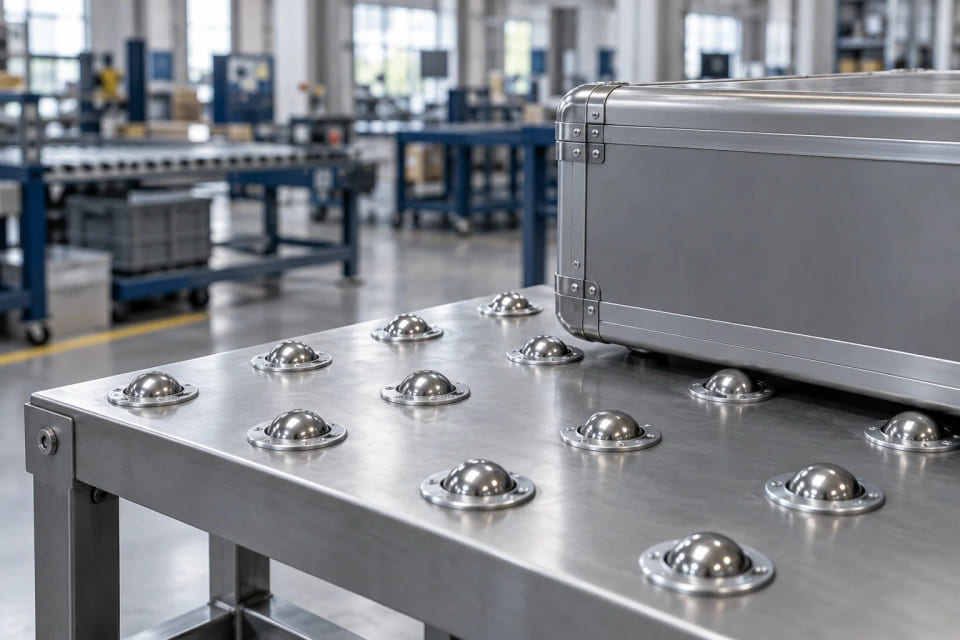
A handling-table enquiry should describe the object being transferred, its underside, support spacing and required motion. An exposed load ball and the smaller support balls inside a unit have different roles. Ask whether the request is for one sphere type, an internal replacement set or the complete unit.
If a surface-sensitive object is involved, compare a suitable polymer candidate and the specified metal option in the actual contact arrangement. Record marking, movement and any wear observations under agreed conditions. A material substitution changes more than appearance and should not be described as an automatic improvement in the table’s load capacity.
5. Food-equipment valve balls: specify the product and the cleaning cycle.
For a food or beverage-equipment component, list the liquid or product, solids where relevant, operating temperature and cleaning agents. The ball and seat need to be reviewed together. A processor’s replacement enquiry should include the installed valve or pump identification and the authority for approving an alternative component.
Separate contact evidence from functional evidence. The buyer may require records for the exact material and finished part, while the assembly test establishes seating and movement under the selected conditions. If the requirement is grinding or refining media instead, move it to the process-media route with its own equipment-approved composition and wear evaluation.
Explore balls for check valves & fluid control ↗
6. Compare the candidate with the function.
Build a separate comparison for each use. A stainless valve ball, hardened rolling ball and polymer load ball should not share one purchasing description simply because all are spheres. Where an item is resold, preserve the end-user application and required records. That lets the distributor offer a useful component rather than an ambiguous nominal-size match.
| Product / material candidate | Why review it here? | Confirm before approval |
|---|---|---|
| AISI 52100 Chrome Steel Balls | Drawing-specified rolling, locating or positioning parts | Confirm material condition, dimensions, contact and protection during storage. |
| 440C Stainless Steel Balls | Approved hardened-stainless contact components | Compare contact requirements and exposure with the released drawing. |
| POM Balls | Suitable handling and contact-surface candidates | Specify resin and test marking, dimensions and movement in the unit. |
| 316 / 316L Stainless Steel Balls | Appropriate wetted food-equipment components | Confirm exact grade, food/cleaning exposure, seat and required contact records. |
Review the linked material information alongside the application requirements. Exact grade, finished dimensions, supply and documents are confirmed for the specific component and order.
Have a component in mind?
Use the candidate list to start a focused discussion. Add the drawing, medium or contact that makes this application specific.
7. Make the specification usable at receiving.
Use the drawing revision or an agreed replacement schedule as the order basis. List material, condition, size and units, form/surface requirements, quantity and records. For a repair without a released drawing, identify who can authorise the proposed specification and what evidence is needed before installation.
The receiving plant should be able to link the pack label, report and reference sample to the same item. If supplier and buyer use different measurement conditions, resolve the difference during sample evaluation. Production acceptance should reproduce the approved requirement rather than restart the selection discussion with every shipment.
| Requirement | Review before sampling | Preserve in the record |
|---|---|---|
| Automation interface | Drawing and assembly-specific contact | Matched part revision and agreed movement/engagement check. |
| Transfer table component | Object contact and complete-unit evaluation | Surface marking, movement and test arrangement. |
| Food valve component | Material/contact scope and functional check | Operating and cleaning media, seat and sample identity. |
8. Localise documents without changing the specification.
Agree whether Polish or English receiving documents are required. Preserve part identifiers, units and limits consistently across both. The useful translation distinguishes a loose ball from an assembled bearing, transfer unit or valve, preventing a catalogue term from expanding the assumed supply scope.
For requested product-contact or substance information, specify the exact material and finished component. Do not assume that a generic stainless description covers every food or cleaning process. Confirm the document scope with the buyer and identify any assessment that must be carried out for the final equipment or use.
9. Plan delivery to the actual receiving team.
Confirm whether goods enter a distributor warehouse, an assembly site or a maintenance department. Where one shipment is split, preserve lot and part identity in each sub-pack. Clear separated packs are especially important when steel grades or nearby diameters look alike.
Specify the final receiving location and any onward customer delivery. Agree which records must remain with the goods and who can accept a discrepancy. The page does not establish Polish stock or a local distribution base; available supply, shipping arrangements and actual lead time require a reviewed order.
10. Compare the cost of an accepted component.
Compare the cost of the component accepted for its intended use. Include the requested inspection, packing, samples and receiving work. For a handling system, keep the ball-component cost separate from the assembled unit and installation; for a food plant, include the necessary validation window.
If a distributor consolidates demand, separate standard repeat items from customer-controlled parts. Aggregating quantity can simplify ordering only when the technical requirements are actually the same. Keep special document, cleaning or packaging requirements visible rather than spreading them ambiguously across every stock item.
11. Move from a sample to a repeatable order.
Choose one representative item and one approval owner. Agree the drawing and receiving method, evaluate a traceable sample in the actual interface and record the result. Use the first repeat lot to verify that the supplier and plant understand the same acceptance basis.
Expand into related products by comparing the requirements, not by assuming an industry-wide approval. A successful load-ball trial does not qualify internal support balls, and a valve-ball approval does not establish a food-media specification. Record the new scope before ordering the next sample.
Function, material, finished requirements and approval owner.
Agreed inspection and application test with recorded conditions.
The accepted revision, lot identity, records and change route.
12. Questions Poland buyers ask.
Which ball products are useful starting points in Poland?
Investigate drawing-controlled mechanical balls, handling-system load balls and specified wetted components for food or process equipment. Confirm each buyer’s actual machine and approval route. The industrial sources establish context, not measured demand for a particular diameter.
Should a transfer system use metal or polymer load balls?
Review the object surface, unit design, layout and movement criteria. A suitable polymer can be considered for a defined contact requirement, but the complete unit must be validated. A loose-ball material choice is not a table load-rating calculation.
What should a Polish food-equipment enquiry include?
Provide the product, cleaning sequence, temperatures, installed pump or valve, seat, dimensions and exact contact-document request. Name the processor or engineering party that approves the sample and any proposed substitution.
Can several plants use one approved ball specification?
Only if their component and acceptance requirements are the same. Compare drawing revision, material, interface, documents and receiving method at each plant. Keep separate approval records where the installed equipment or duty differs.
13. Prepare a Poland component brief.
Illustrative request: a Polish handling integrator is comparing a steel and a polymer load-ball candidate for a transfer unit. Provide the unit configuration, object underside, support arrangement, movement and permitted marking criteria. Test each candidate in the same compatible unit. Keep the load-ball item separate from the internal supporting balls and retain the accepted material, dimensions and sample identity in the repeat order.
Select the candidates and review topics relevant to your component. Add the size and quantity if known, then carry this brief into the enquiry page.
Select the product candidates and review topics you want to discuss.
The enquiry page prepares an email draft for your review. Nothing is sent automatically. Exact supply, documents and delivery terms are confirmed in the quotation.
Preview my enquiry brief
Market: Poland
Sources and editorial scope
Research reviewed on 21 October 2026. Dated official publications establish industrial context. Buyer segments, product shortlists, sample plans and procurement examples are MEITUO-oriented editorial recommendations, not measured local ball demand, customer cases or national purchasing requirements.
- International Trade Administration: advanced manufacturing mission to Türkiye and PolandSeptember 2025 mission. Industrial automation and precision machinery priorities. Historical mission, not a future event.
- Statistics Poland: Concise Statistical Yearbook of Poland 20252025 publication; individual data retain their reference years. Manufacturing activity classification, including food and beverages; no forecast of loose-ball purchases.
Application and material guidance is connected to the linked MEITUO application library and its technical references. Candidate products do not imply confirmed stock, certification, system ratings or qualification for every use. Images are explanatory CGI concepts.
A ball-focused website of Qingdao Meituo Steel Co., Ltd. Read the company profile or discuss the actual component.