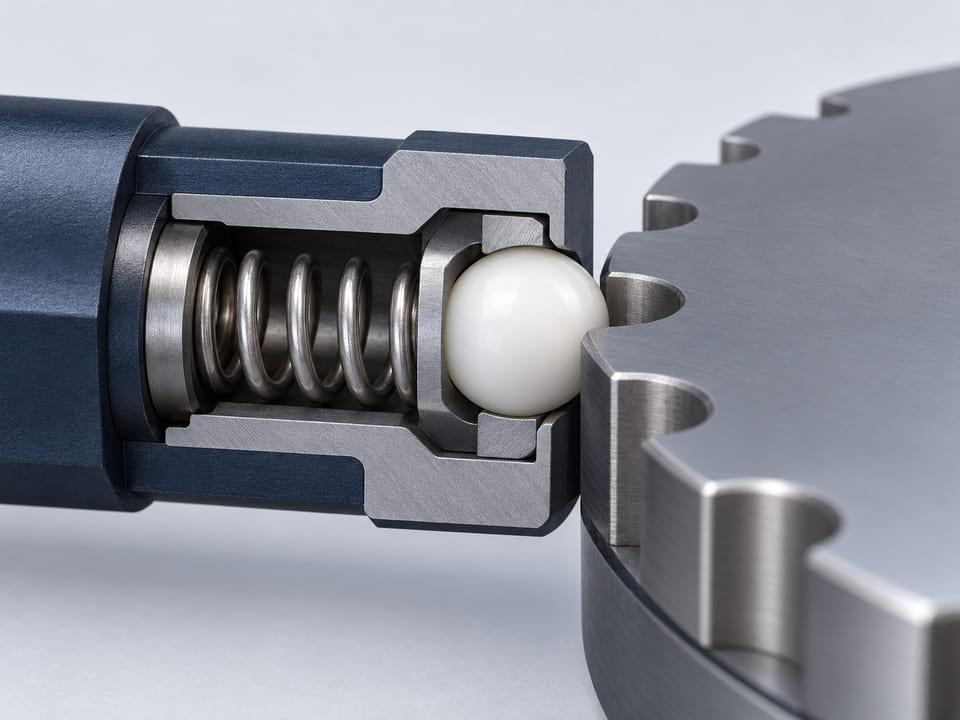
Which plastic ball should I choose first?
Start with the limiting condition: fluid exposure, moisture-dependent fit, loaded deformation, transparency, elastic recovery or sensing. Use it to shortlist materials, then compare exact grades and the assembled function. A universal ranking would hide the difference between a floating element, an indexing contact and a pressure-loaded valve sphere.
Does plastic-ball precision use the same basis as steel?
Do not assume that a familiar grade label defines the same acceptance. Specify diameter, form, surface and the inspection conditions directly. For polymers, conditioning and measuring force can matter. If movement or leakage after exposure determines success, include that check instead of relying solely on an unloaded dimensional inspection.
Are nylon and acetal interchangeable?
They are different engineering polymer families. Nylon requires particular attention to moisture conditioning, while POM also needs its exact resin type and fluid review. Matching the initial diameter does not establish equivalent fit, friction or endurance after humidity, immersion or loaded dwell in the actual mechanism.
Does a higher temperature rating make PEEK the best choice?
No. A published thermal property does not determine complete ball performance. PEEK needs a compound-specific review of fluid, contact, load and duration. If a simpler material already meets the validated requirement, a higher-cost polymer may add no useful benefit. Identify the combined condition that justifies the change.
Can filled compounds be substituted for unfilled resin?
Only after an explicit review. Fillers can change stiffness, surface interaction, conductivity and debris, as well as chemistry or documentation. State the required formulation and permitted alternatives. A dark or ivory appearance is not evidence of filler content, and a material change should not be hidden behind the same polymer-family name.
Are plastic balls automatically food-contact or medical compliant?
No. The exact grade, additives, finished-component route and intended contact determine the evidence needed. State the application, market, medium, temperature and duration. A general polymer description or another manufacturer's declaration cannot establish the required conformity of the proposed component for a regulated use. Confirm the required scope before ordering.
Why specify solid or hollow construction?
Effective density, wall integrity and pressure response can differ even when the exterior material and diameter match. This is particularly important for a floating sphere. Identify the intended construction and required integrity, then validate movement or buoyancy in the relevant liquid rather than inferring the design from a product image.
What is the fastest way to make quotations comparable?
Send the same material identity, geometry, conditioning, exposure, quantity and sample acceptance to each supplier. Identify which alternatives are allowed and what evidence is required. This makes a lower-priced proposal reviewable and prevents unnoticed differences in compound, surface quality, inspection scope or the function expected from the finished sphere.