Connect the material
with the application.
Use these references to frame an industrial ball enquiry. A material family does not define the complete part: exact grade, dimensions, contact, surface and operating conditions still need to be specified. Follow an application link to see why those requirements differ.
AISI 52100 Chrome Steel Balls
A bearing-steel reference for components that specify hardened rolling or repeated contact. Review the material condition and finished-ball geometry with the mating race or mechanism.
Define for your enquiry. Exact grade and condition, dimensional limits, surface, lubricant and exposure.
Carbon Steel Balls
Carbon steel describes a family rather than one finished-ball specification. Keep the actual steel designation, material condition and surface requirements attached to the application.
Define for your enquiry. Material designation, treatment, size limits, contact and corrosion-protection requirements.
Discuss This Material440C Stainless Steel Balls
A hardened-stainless candidate to review for rolling or repeated contact where the component design calls for it. Contact and exposure must be assessed together.
Define for your enquiry. Material condition, geometry, mating surface, lubrication and cleaning exposure.
420C Stainless Steel Balls
A hardened-stainless material reference for specified mechanical contact, including suitable detent or plunger designs. The assembly drawing remains the acceptance authority.
Define for your enquiry. Condition, ball size, projection or contact geometry, cycling and environment.
Discuss This Material302 / 304 / 304L Stainless Steel Balls
A stainless material family for appropriate fluid-contact, packaging or process duties. Identify the actual grade; these names are not interchangeable order descriptions.
Define for your enquiry. Grade, size, surface condition, formulation or fluid, and required contact documents.
316 / 316L Stainless Steel Balls
Review a stainless material candidate for suitable pumps, valves, packaging and other components. A corrosion-related selection still needs contact and dimensional acceptance.
Define for your enquiry. Exact grade, medium, temperature, contact conditions, drawing and inspection scope.
Read the product specification ↗
Discuss This MaterialSilicon Nitride Balls
A ceramic reference for purpose-designed bearing or precision-contact systems. A hybrid-bearing material change requires review of the races, clearance and operating conditions.
Define for your enquiry. Ceramic specification, component geometry, contact requirements and assembly validation.
Discuss This MaterialAlumina Balls
An industrial ceramic candidate for selected fluid-contact or process-media duties. Specify composition and finished-part requirements rather than using white colour as material identification.
Define for your enquiry. Exact ceramic grade, size, surface, chemical exposure and application-specific inspection.
Zirconia Balls & Grinding Beads
A ceramic reference for suitable grinding, dispersion or component designs. Media composition, wear and the equipment-approved specification need to be reviewed together.
Define for your enquiry. Ceramic formulation, size distribution, mill compatibility, wear and contamination acceptance.
Discuss This MaterialPTFE Balls
A fluoropolymer candidate for appropriate wetted components. Chemical compatibility is only part of the specification: guidance, contact deformation and function also matter.
Define for your enquiry. Exact material, fluid concentration and temperature, geometry, seat and acceptance.
PVDF Balls
An engineering-fluoropolymer reference for a chemical-handling review. Its suitability is determined by the actual grade, exposure sequence and component function.
Define for your enquiry. Resin grade, dimensions, operating and cleaning media, contact and required records.
Discuss This MaterialPEEK Balls
A high-performance polymer candidate where the application calls for a combined thermal, chemical and mechanical review. Exact compounds can differ significantly.
Define for your enquiry. Unfilled or specified compound, medium, temperature, size limits and contact acceptance.
Read the product specification ↗
Discuss This MaterialPOM Balls
An engineering-polymer reference for suitable mechanical, packaging or interface designs. The resin, surface and dimensions must fit the component and its working environment.
Define for your enquiry. Resin specification, size and form limits, exposure, contact and functional validation.
Nylon / PA Balls
A polymer candidate for appropriate contact or material-handling requirements. Identify the polyamide grade and relevant environmental conditions for dimensional and functional review.
Define for your enquiry. Resin, conditioning requirements, geometry, contact, wear and operating environment.
Discuss This MaterialPP Balls
A polymer family to review for a suitable wetted or buoyancy-related component. The finished construction and mass matter alongside the resin identity.
Define for your enquiry. Grade, solid or hollow construction, geometry, liquid conditions and finished-part acceptance.
Discuss This MaterialHDPE Balls
A polymer reference for a defined component review. Do not infer a finished float or fluid-contact component’s suitability from the broad material name alone.
Define for your enquiry. Resin, finished dimensions and mass, exposure and the actual functional requirement.
Discuss This MaterialPMMA Balls
A polymer material option for an interface whose design explicitly permits it. Appearance and transparency do not establish sensor compatibility.
Define for your enquiry. Material, surface or pattern, dimensions, contact and complete-module validation.
Discuss This MaterialGlass Balls
A glass reference for suitable packaging, valve or component requirements. Specify the glass type, finished surface and contact acceptance; clear appearance does not establish composition.
Define for your enquiry. Glass designation, dimensions, surface defects, impact conditions and formulation contact.
Steel Grinding & Refining Balls
Process media should be accepted against the equipment and product requirements, rather than a bearing-ball specification. Wear and material contribution may affect the process result.
Define for your enquiry. Steel condition, media size distribution, machine specification, wear and contamination limits.
Discuss This MaterialBall Burnishing Media
Metallic spherical media for an appropriate surface-finishing process. Separate burnishing from abrasive cutting or particle-size reduction, and review the actual workpiece geometry.
Define for your enquiry. Material, size mix, surface, process chemistry, lodging and separation requirements.
Discuss This MaterialShaped Finishing Media
Non-spherical media are a separate process choice where shape affects access, contact or separation. Compare against the workpiece and desired surface change.
Define for your enquiry. Shape, material, size, equipment, part features and process acceptance.
Discuss This MaterialSolid Elastomer Balls
A compound-specific candidate for appropriate mechanical-deblinding or other designs. Solid construction must be distinguished from a coated metal core.
Define for your enquiry. Compound, hardness requirement, dimensions, rebound, temperature, contact and wear.
Discuss This MaterialRubber-Coated Balls
A composite construction whose core and coating both affect contact and behavior. It is not another name for a solid elastomer sphere.
Define for your enquiry. Core and coating, finished geometry, adhesion, exposure and functional acceptance.
Discuss This MaterialOptical & Mechanical Trackballs
A purpose-specified sphere for an input interface. Sensing surface, support contact and retention need validation in the actual module.
Define for your enquiry. Ball versus module scope, sensing technology, pattern, dimensions and movement acceptance.
Discuss This MaterialStainless Steel Hollow Balls
A hollow construction to review for an actual component drawing. Buoyancy and sealing concern the finished assembly, not merely the shell material or diameter.
Define for your enquiry. Material, total mass, seams, attachments, leak acceptance and operating liquid.
Discuss This MaterialOne material name is not a finished specification.
State the exact grade or compound, finished size limits, surface and the conditions the ball will face. If documents are needed for contact, qualification or receiving inspection, identify their scope in the enquiry.
New materials and special structures require an application and supply review. Appearance or colour does not establish material identity or acceptance.
Review inspection requirements ↗Need to narrow the material choice?
Start with the ball’s role, medium, temperature and contact. Explain which requirements are fixed and which need review.
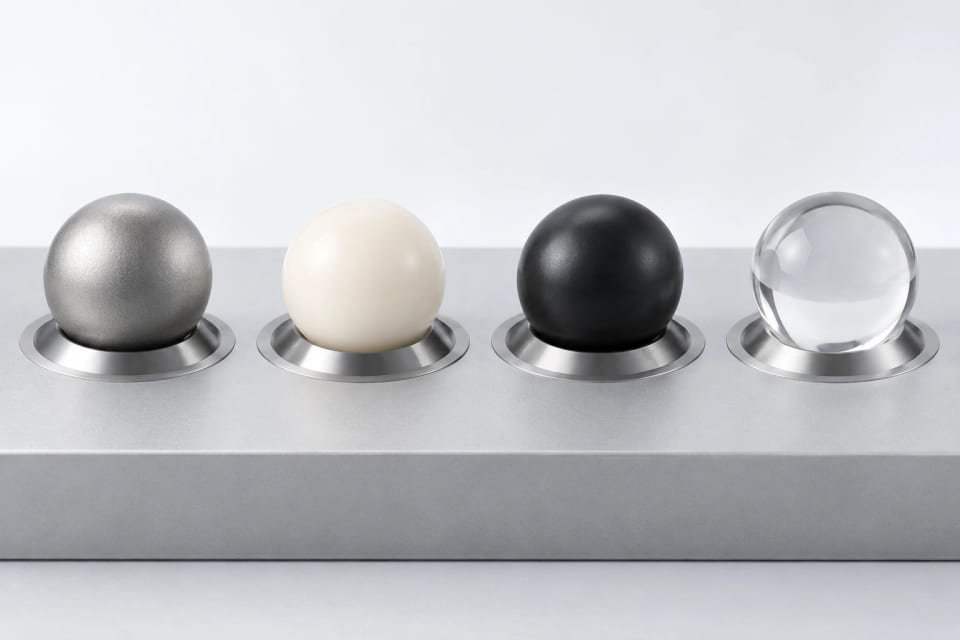
Compare the material families around the application.
These material examples illustrate different physical families; the exact grade and finished-component requirements remain part of selection.
Material selection →