Skip to content
Industrial balls & precision componentsinfo@meituoballs.com
MEITUO Balls

Find a product, application or guide.

Project review

Engineering Project Enquiries

Turn a material question or component problem into a defined feasibility and validation brief.
Quick answer

An engineering project enquiry should define the function, constraints and evidence needed for the next decision before choosing a ball material or construction. MEITUO Balls provides a route to discuss drawing-based components, material comparisons and interface proposals. Feasibility, sourcing, samples and testing must be reviewed for the project, with responsibilities stated explicitly; an enquiry does not establish existing development, laboratory or complete-system qualification capability.

CGI concept of an intact coated-core sphere, its deliberate section and a separate seat
Compare construction and contact before choosing a project direction · CGI concept
CHOOSE YOUR NEXT STEP

Find the right route for your requirement.

01

Material decision projects

Define the limiting condition and the alternatives being compared. Include the fluid, temperature, contact, movement and current failure or constraint. This route is useful when the geometry is broadly understood but the material needs review. The comparison should explain the tradeoff and required evidence rather than name a universal best sphere material.

02

Construction and interface projects

Describe the mechanism and the features that distinguish a solid, hollow, threaded, coated or paired component. Provide the surrounding interfaces and required outcome. This route brings hidden geometry and supply boundaries into the brief so a visually similar sphere is not mistaken for an equivalent assembly component or complete tested device.

03

Validation planning

State the question the next sample or test needs to answer, the fixture or assembly involved and who can approve the result. Geometry, material evidence, exposure and functional performance should have separate criteria. Use this route to define a decision gate before a sample is treated as proof of a wider design or supply scope.

The most useful first question is often what the next sample must prove. A design team may be comparing polymer and ceramic contact, reconsidering a solid sphere's mass, or defining a ball-and-seat interface. These are different projects with different evidence needs. Describe the current condition and the decision you want to make, then separate component inspection from assembly validation. A practical project brief keeps unknowns visible and establishes who owns each technical decision before sourcing or sample commitments are made.

01 / IN CONTEXT

Describe the problem without hiding the unknowns

Identify the function and observed limitation using the most direct evidence available. This might be sticking after moisture exposure, excessive wear against a particular counterface, leakage after dwell or a moving mass that changes response. Share the drawing revision, operating history and test conditions that make the observation meaningful. If the cause is unknown, label it as a question rather than converting it into a material conclusion. For example, a switch from POM to PEEK should be justified by the relevant duty, not by a general high-performance label. Describe the non-negotiable constraints and where a redesign is possible. This keeps the opening discussion focused on a decision that evidence can support rather than an undefined promise to improve everything. Identify that decision owner.

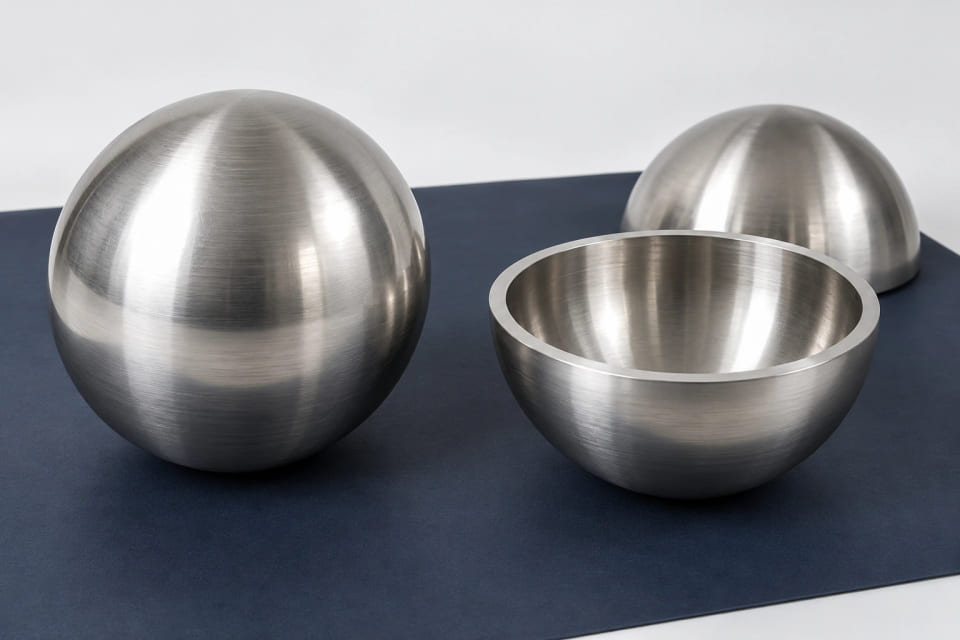
CGI concept comparing a solid metal sphere with the two open halves of a hollow-shell construction
Make mass and construction questions explicit in the project brief · CGI illustration
02 / IN CONTEXT

Set a decision gate before the sample

Define the smallest useful review or trial that distinguishes the alternatives. Material identity, finished geometry, exposure response and assembled function can be separate gates. A paired ball-and-seat proposal needs a defined interface and leakage method; a metrology artefact proposal needs a verified calibration arrangement and measurement deliverable. State the required documents, fixture, acceptance and approval owner before agreeing samples. Identify what the trial will not establish as well, such as complete equipment endurance or qualification of a different drawing revision. Record the result and unresolved questions so the project can proceed, change direction or stop on a clear technical basis. A decision gate is useful when it reduces uncertainty, not when it simply produces another attractive sample. Retain the applicable test revision.

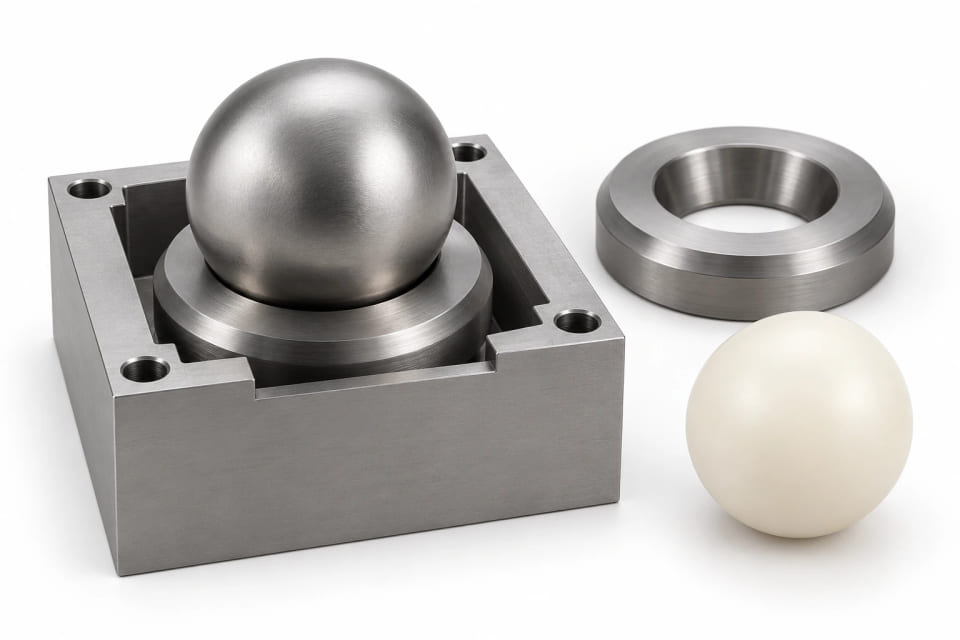
CGI concept of a ball-and-seat interface in a simple fixture beside an alternative sphere and separate seat
Set a component-level decision gate with a defined interface · CGI concept
03 / IN CONTEXT

Make sourcing and test responsibilities explicit

A project can involve the component supplier, material source, test provider and equipment owner, with different roles in the final result. Identify who proposes the grade, who inspects the ball, who provides the seat or mounting fixture, and who validates the complete system. If an external laboratory or specialist source is needed, establish its proposed scope and evidence before relying on it. Do not infer that a broad company materials background includes every ball-processing or calibration capability. Review confidentiality and information-sharing needs through the agreed communication process, and distinguish feasibility discussion from a commercial order. Each later commitment should state the deliverable, acceptance, quantity and terms, with a change review if the drawing, medium or project objective moves beyond the earlier evidence.

A SHARED REVIEW BASIS

Frame the next engineering decision

Scroll the table to compare requirements →
Frame the next engineering decision
Project inputProvideDecision it supports
FunctionWhat the sphere does in the assembly.What outcome must be preserved?
EvidenceObserved issue and relevant test conditions.Which cause remains uncertain?
ConstraintsGeometry, material restrictions and environment.Which alternatives are feasible to review?
InterfacesSeat, race, guide, thread, mounting or housing.What must be validated together?
GateSample or test with an acceptance method.What result authorises the next step?
OwnershipSpecification, sourcing, test and approval roles.Who is responsible for each deliverable?
WORKING SEQUENCE

Make the next conversation specific.

  1. 01

    Frame the question

    Describe the function, observed limitation and decision being made. Share relevant geometry and operating evidence, and label assumptions honestly. The opening brief should show which constraints are fixed and which aspects of material, construction or assembly can be reconsidered.

  2. 02

    Review feasible directions

    Compare candidate materials or constructions against the actual duty. Identify the proposed source, document and inspection questions without assuming they are already resolved. The output should be a reviewable direction and an evidence gap, rather than an unsupported claim of a completed engineering solution.

  3. 03

    Agree the validation gate

    Define the sample identity, test conditions, acceptance and approval owner before proceeding. Separate component inspection from assembly or laboratory work, and confirm the proposed responsibility for each. Make clear which further validation remains if the first sample meets its limited acceptance.

  4. 04

    Record the decision

    Evaluate the evidence against the question and record whether to proceed, revise or stop. Preserve open items and the applicable drawing revision. Any commercial supply or broader development scope should then be agreed explicitly, using the accepted result rather than assuming an unrestricted project capability.

PRACTICAL ANSWERS

Questions before the next step.

Can I enquire with a failure description rather than a fixed product?

Yes. Provide the function, drawing or representative assembly, observed issue and operating conditions. State what is known and what remains uncertain. A useful review can begin with the decision you need to make, without pretending that the correct material or construction has already been identified.

Does this page promise in-house research or laboratory services?

No universal development or laboratory capability is claimed. The project must establish the proposed sourcing, inspection and testing roles, including any specialist provider needed. A materials-business background does not prove every ball-processing, calibration or system-validation capability required by a particular engineering enquiry.

How should two candidate materials be compared?

Use the same relevant duty and acceptance, including the actual counterface, fluid, temperature and exposure. Compare finished components rather than isolated favourable properties. Record changes in mass, deformation or geometry that affect the assembly, and identify the test needed to show whether either candidate solves the original problem.

Does a successful sample prove long-term system performance?

Only the agreed sample acceptance has been demonstrated. Endurance, different operating conditions or complete-system qualification may need further evidence. Define those responsibilities before the trial and preserve its limits in the result. A component test should not silently become approval of every application or drawing revision.

What if a calibrated sphere or specialist report is required?

Define the measurand, uncertainty or report scope and the evidence your project needs. The proposed laboratory or specialist arrangement must be established before committing to that deliverable. An ordinary dimensional report or precision-component label does not substitute for a calibrated reference or an unrelated qualification document.

How are scope changes handled during the project?

Identify the changed drawing, medium, duty or objective, then review whether earlier proposals and evidence still apply. Update the acceptance and responsibilities before the next commitment. This keeps a material comparison or sample order connected to its actual purpose rather than allowing an informal change to create an unreviewed supply or performance promise.

BRING YOUR REQUIREMENT

Define the question your next sample must answer

Share the function, evidence, constraints and proposed decision gate for a project review.

Prepare an enquiry ↗