On this page
Which industrial balls should Mexico buyers compare?
For industrial ball sourcing in Mexico, distinguish a vehicle component from a production-machine part and a plant-utility ball. Automotive programmes need the controlling customer drawing and approval route; automation parts need the actual motion interface; utility dosing needs medium and valve information. Connect the Mexican receiving plant with any overseas design authority, preserve units and revision, and compare the complete component evidence before discussing repeat supply.
Clarify whether the ball enters the vehicle, the production tool or the utility system. Connect the receiving plant with the drawing owner before sampling.
1. Read the industrial signals through the component.
- The ITA’s February 2026 automotive guide describes closely integrated vehicle and spare-part production between Mexico and the United States. That context makes cross-plant drawing and approval coordination relevant. [1]
- The ITA’s February 2026 advanced-manufacturing guide discusses automation across several Mexican manufacturing sectors. It supports investigating production-equipment components separately from parts built into the finished vehicle. [2]
Our recommended content focus is the practical handoff between engineering, purchasing and the receiving plant. A Mexican facility may assemble a customer-designed product while another office controls its component drawing. The same facility may also buy general maintenance parts locally. These purchasing paths should not share a generic specification or assume the same authority for material changes.
2. Turn the local account into a useful enquiry.
| Buyer / catchment | Investigate this requirement | Ask before shortlisting |
|---|---|---|
| Northern manufacturing interview routes | OEM, component and automation programmes | Identify whether the drawing owner is local or overseas. |
| Bajío interview routes | Vehicle-component and machinery accounts | Separate finished-product parts from tooling and plant maintenance. |
| Central and other receiving sites | Purchasing, distributors and process utilities | Confirm the actual factory, technical approver and delivery address. |
These are proposed interview routes, not a measured ranking of ball demand. Validate the company’s actual component and current receiving location. A cross-border customer relationship does not establish a component’s origin or trade eligibility; those details must be reviewed for the actual supply chain.
3. Automotive ball components: align the Mexican plant and design authority.
Begin with the customer part number, drawing revision and component function. A sphere used for rolling contact may have different requirements from one used for a detent or fluid interface. Identify who can approve the sample and who can authorise a material, process or source change.
Use one acceptance schedule across the purchasing office, Mexican receiving plant and any overseas engineering team. Preserve the drawing’s units and limits; do not translate an inch requirement into a nearby metric catalogue size. If customer submission records are needed, define their exact content before sampling and connect them to the supplied lot. Local fit alone may not be the complete production-release decision.
Explore balls for automotive components ↗
4. Automation and handling: distinguish the production tool from the product.
A ball in a fixture, slide or transfer table is part of the production system, even when that system makes automotive components. The acceptance should follow the machine interface: contact surface, movement, lubrication, layout and environment. Do not automatically apply a vehicle-part document package to an unrelated machine component, or omit a required fixture drawing because it is called maintenance.
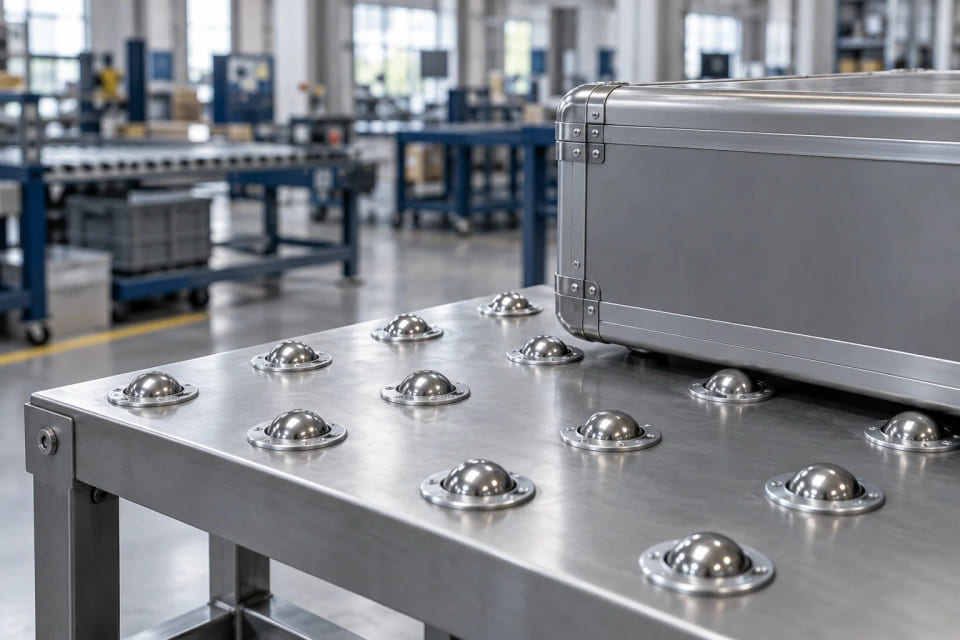
For ball-transfer equipment, specify whether the enquiry covers exposed load balls, internal supporting balls or complete units. Test movement and marking with the actual handled object. Keep the ball-component supply scope separate from a rated unit or table. A material change must be reviewed with the housing and support arrangement.
5. Plant dosing and utility valves: write the actual circuit conditions.
A manufacturing plant can have chemical dosing, cleaning and general utility-water duties that require different materials. State which circuit the ball belongs to, what liquid it contacts, its concentration and temperatures, and the cleaning/shutdown sequence. Include the seat and pump or valve identification.
Compare stainless or polymer candidates around compatibility and complete-valve function. The sphere must still move and seat correctly in the design. If a failed component is available, include photographs and observations, but use an authorised dimensional specification rather than assuming a worn sample reproduces the original requirement. Agree how the replacement will be accepted before choosing an urgent shipment.
Explore check balls for metering & dosing pumps ↗
6. Compare the candidate with the function.
Use the buyer’s actual part and drawing as the shortlist boundary. Automotive, tooling and utilities can share a purchasing department but need different component evidence. Keep a proposed material or size alternative visible for the responsible engineer. If the finished assembly moves across borders, record the component’s actual supply origin rather than inferring it from the final assembly location.
| Product / material candidate | Why review it here? | Confirm before approval |
|---|---|---|
| AISI 52100 Chrome Steel Balls | Drawing-specified automotive or machine rolling components | Confirm material condition, geometry, units and the customer/assembly approval route. |
| 440C Stainless Steel Balls | Approved hardened-stainless contact candidates | Review the complete mechanical duty and exposure; make alternatives explicit. |
| 316 / 316L Stainless Steel Balls | Suitable plant-pump or valve components | Confirm medium, cleaning conditions, seat, surface and finished-part records. |
| POM Balls | Suitable handling or surface-contact components | Specify resin, dimensions and complete-unit marking/movement acceptance. |
Review the linked material information alongside the application requirements. Exact grade, finished dimensions, supply and documents are confirmed for the specific component and order.
Have a component in mind?
Use the candidate list to start a focused discussion. Add the drawing, medium or contact that makes this application specific.
7. Make the specification usable at receiving.
Prepare a bilingual-ready technical schedule with the same part number, revision, units and limits in every version. State material and condition, finished characteristics, sample quantity, release quantity and records. Identify who signs dimensional acceptance and who signs the assembly/customer approval.
For a multi-plant programme, compare the installed configuration at each receiving site before sharing an approval. A common customer part number can simplify procurement, but only the released specification and documented acceptance show that the same component is authorised. Update the purchasing record when engineering approves a change.
| Requirement | Review before sampling | Preserve in the record |
|---|---|---|
| Customer drawing part | Units, material, geometry and requested submission | Mexican receiving record linked to the design owner’s approval. |
| Production-machine component | Contact and motion in the installed equipment | Machine revision, sample identity and functional test. |
| Utility valve | Fluid exposure plus seating/movement | Circuit, medium, seat and agreed acceptance conditions. |
8. Localise documents without changing the specification.
Agree whether Spanish receiving instructions are needed alongside the controlling English or other customer drawing. A clear specification distinguishes bola suelta from an assembled bearing or valve. Keep the component scope, numerical values and units unchanged rather than relying on a literal catalogue-name translation.
If a customer asks for origin, material or regulatory information, identify the exact item and document scope. Incorporation into a Mexican assembly does not independently establish the origin treatment of an imported sphere. The responsible purchasing/import team should review the actual supply chain and current rules for that transaction.
9. Plan delivery to the actual receiving team.
Name the final Mexican receiving plant and clarify whether samples will be forwarded to another country for approval. Keep the lot reference and part label attached through each transfer. For production, agree pack quantities, separated sizes and the records that the plant needs at receiving.
Distinguish production lead time from international transport, onward delivery and customer approval time. An urgent component request should still identify the drawing and acceptance authority. This page does not claim Mexican stock, a local warehouse or a fixed cross-border delivery time; actual terms are reviewed per order.
10. Compare the cost of an accepted component.
Compare cost at the accepted component and release quantity. Include requested sample submission, inspection, packing, transport, receiving work and current import-related inputs supplied by the buyer’s responsible team. A nominally cheaper sphere is not a comparable offer if it omits the customer-controlled characteristics.
For plant maintenance, evaluate whether a component repair is authorised and how it affects the equipment acceptance. For a repeat automotive programme, evaluate change-control and documentation effort. These are different decisions, even when both orders are issued by the same Mexican purchasing office.
11. Move from a sample to a repeatable order.
Start with one part and a written approval chain. Review the sample evidence locally, obtain any required overseas engineering decision and record the approved reference. Do not treat a sample’s physical arrival as approval to release production.
Use the first production lot to confirm the drawing, labels, records and receiving method. Resolve any mismatch before extending supply to another site or programme. Where the material, source or process changes, follow the agreed notification route rather than relying on an earlier approval for a different configuration.
Function, material, finished requirements and approval owner.
Agreed inspection and application test with recorded conditions.
The accepted revision, lot identity, records and change route.
12. Questions Mexico buyers ask.
What is the first question for a Mexico automotive-ball enquiry?
Ask whether the sphere goes into the customer product, the production machine or a plant utility. Then identify the drawing, units, approval owner and required sample evidence. These routes can have different documentation and change-control requirements.
Can a Mexican plant approve a sample without the overseas design office?
That depends on the programme’s approval authority. Define who accepts dimensions, material changes and assembly performance. A local trial can support the decision, but the customer’s required approval must still be recorded before production release.
Does assembly in Mexico determine the imported ball’s origin treatment?
Do not infer that from the assembly address. Identify the actual component source and supply chain and have the responsible purchasing/import team review the applicable transaction. This guide does not promise a tariff rate or trade-agreement eligibility.
What should a Spanish-language RFQ preserve?
Keep the controlling part number, drawing revision, units, material and acceptance limits identical to the engineering source. Clarify whether the scope is a loose ball or an assembled product and include the final receiving plant and document requirements.
13. Prepare a Mexico component brief.
Illustrative request: a Mexican plant buys a ball for a customer-designed automotive component whose drawing owner is overseas. Supply the controlled item number, revision, original units, material condition and sample-record request. Identify who signs local dimensional acceptance and who signs the customer release. Preserve both decisions in the first production order. Keep any tool-maintenance ball on a separate approval path.
Select the candidates and review topics relevant to your component. Add the size and quantity if known, then carry this brief into the enquiry page.
Select the product candidates and review topics you want to discuss.
The enquiry page prepares an email draft for your review. Nothing is sent automatically. Exact supply, documents and delivery terms are confirmed in the quotation.
Preview my enquiry brief
Market: Mexico
Sources and editorial scope
Research reviewed on 21 October 2026. Dated official publications establish industrial context. Buyer segments, product shortlists, sample plans and procurement examples are MEITUO-oriented editorial recommendations, not measured local ball demand, customer cases or national purchasing requirements.
- International Trade Administration: Mexico automotive industry11 February 2026. Integrated automotive and spare-part production ecosystem.
- International Trade Administration: Mexico advanced manufacturing10 February 2026. Automation and production-system modernisation across manufacturing sectors.
Application and material guidance is connected to the linked MEITUO application library and its technical references. Candidate products do not imply confirmed stock, certification, system ratings or qualification for every use. Images are explanatory CGI concepts.
A ball-focused website of Qingdao Meituo Steel Co., Ltd. Read the company profile or discuss the actual component.